
Eryngium baldwinii
(Baldwin's Eryngo)
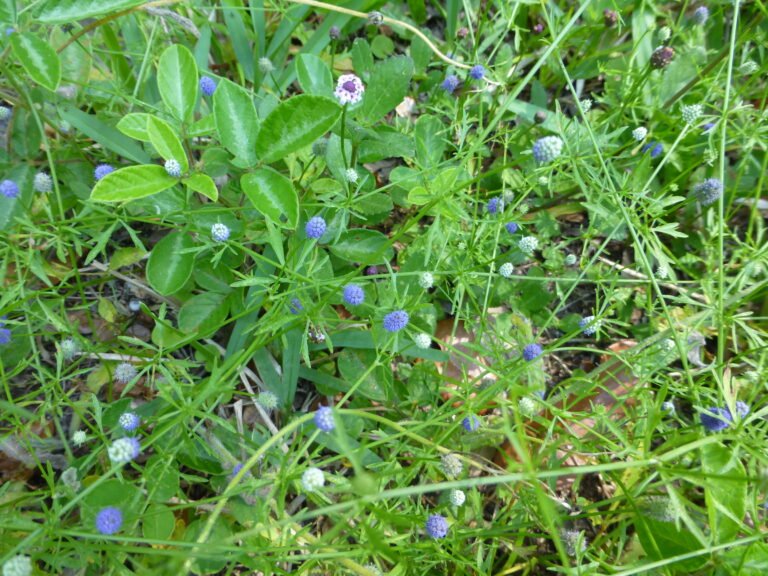
Common Name, Latin Name, and Family
Common names include blue eryngo and Baldwin’s eryngo.
Its Latin name is Eryngium baldwinii.
It is found in the Apiaceae, or carrot, family.
Form
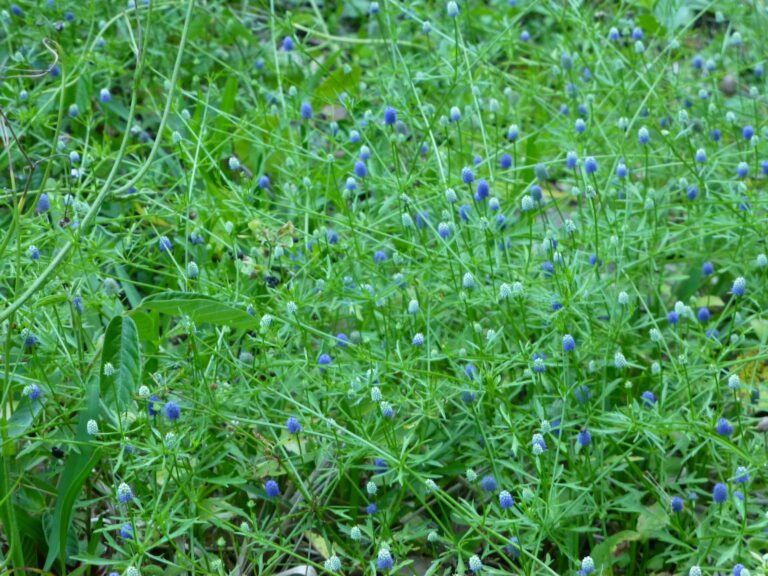
It is a perennial wildflower that grows to about a foot in height and spreads out prostrate as a ground cover.
Leaves
The leaves are alternate with toothed margins and deeply cut lobes. They are elliptic to elliptic-ovate in overall shape.

Flowers
The tiny blue flowers appear spring through fall.

Habitat
It occurs naturally in moist meadows, roadsides, woodland borders, riparian areas, and wet woodlands.
Native Range
It is native to Florida and Georgia. In Florida it can be found from Holmes county south to Monroe Mainland.
Landscape Use
In the home landscape it grows in full sun to part shade with average to moist soils.
It looks best allowed to spread out as a ground cover. Since the flowers are very small it looks better with more flower stems crossing over each other so more flowers are concentrated in any given area.
Wildlife Uses
The flowers are a nectar source for many small insects and squirrels and songbirds eat the flowers and seeds.
Since it is found in the carrot family it should attract the eastern black swallowtail butterfly to use it as a host plant, but I have not had the opportunity to see that in my green space yet and I have had it growing in every place I’ve lived in Florida.
Propagation
Propagation is achieved by growing it from seed or transplants.
It roots at leaf nodes that touch the ground so any piece of the plant that has roots can be transplanted to a moist site.