Beetles in my Backyard
Beetles are found in the order Coleoptera with almost 400,000 species worldwide making it the largest order of animals in the world. In Florida we have a little over 4600 species that include aquatic beetles, ground beetles, scarab beetles, and wood boring beetles. Following are just a few that visit my back yard.
A beetle begins its life cycle as an egg, then the larva hatch (looking nothing like the adult) and eat their favorite food, grow larger and shed their skins, until they reach the right size, then they pupate into a cocoon, which eventually hatches into an adult beetle. Bugs on the other hand emerge from the egg as a nymph (a miniature version of the adult) and as it eats, and grows, in sheds its exoskeleton (outer skin) until it gets to an adult size. Also bugs do not have the added security of an armor plated wing covering as beetles do.
Beetles have hard forewing coverings called elytra. These strong coverings protect their more fragile flight wings that are underneath. The elytra is usually very colorful and ornate. Coleoptera means “sheath wings” in Greek. [1]
Beetles come in many shapes and sizes from so small they are barely visible to the naked eye to 6 ½ in length. The colors are also almost endless. Their hard wing coverings are usually beautifully colored and have been used as decorations for clothing, hats, and broches throughout history.
Some beetles are very specialized and eat only certain things such as gopher tortoise dung and the inner material of mistletoe stems. So many Florida beetles live completely unnoticed lives and are rarely seen unless one is specifically looking for them. One easy way to find beetles is to watch around your porch light at night or check rotten logs or stored wood.
The lady beetles, or ladybugs, most of us see in our green spaces are non-native species and most of the ones sold online are the non-native ones as well which is why I have never purchased and released the ones sold online. However there are now several companies that sell native lady beetles, and Cornell University has a program to help find where our native lady beetles are being seen in our yards and gardens. Please take the time to participate in the Lost Ladybug Project if you can even though it focuses more on New York and Hippodamia convergens (convergent lady beetle) it’s still important to share sightings. I didn’t want to highjack this beetle article so I updated my Ladybug article to Lady Beetles Native to Florida – so please follow the link to get more detailed information on our native lady beetles.
If you find any errors please email me with the correction and your source. Thanks!
Alaus oculatus
(eastern eyed click beetle)
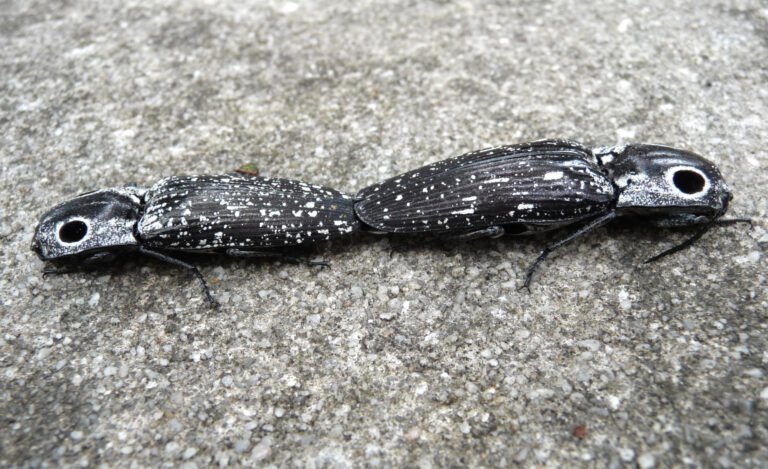
Description: the eastern eyed click beetle is long and narrow and grows from 1 to 1 3/4 inches in length. They are black with white, almost silvery, splotches from head to tail. They have a large pair of decorative eyes on their pronatum (area just behind the head) that are black circled in silvery white making this beetle look large and ferocious to predators. Their elytra (wing coverings) are ridged lengthwise.
Common Names: eastern eyed click beetle, eyed elator, big eyed beetle, click beetle elater, snapping beetle, spring beetle or skipjack.
Latin Name: Alaus oculatus.
Family: the eastern eyed click beetle is in the Elatericae, or click beetle, family.
Behavior: This beetle has a very unique means of escaping predation, and providing entertainment for countless children and adults alike. When the beetle is put on its back it makes a loud click to right itself. The click is made by “The front section of the thorax is attached to the rest of the body with a kind of hinge, below which is a projection from the front section of the thorax which fits into a corresponding cavity on the rest of the body. … After building up muscular pressure, the beetle releases the catch, and the projection slams back into the cavity with a powerful (and audible) snap. [2]
Habitat: the eastern eyed click beetle is found in almost all forests, from hardwood to deciduous, with large dead, or dying, trees because they lay their eggs underneath the bark of those trees.
Range: the eastern eyed click beetle is found throughout Florida and the eastern United States from north into Canada and south throughout Florida.
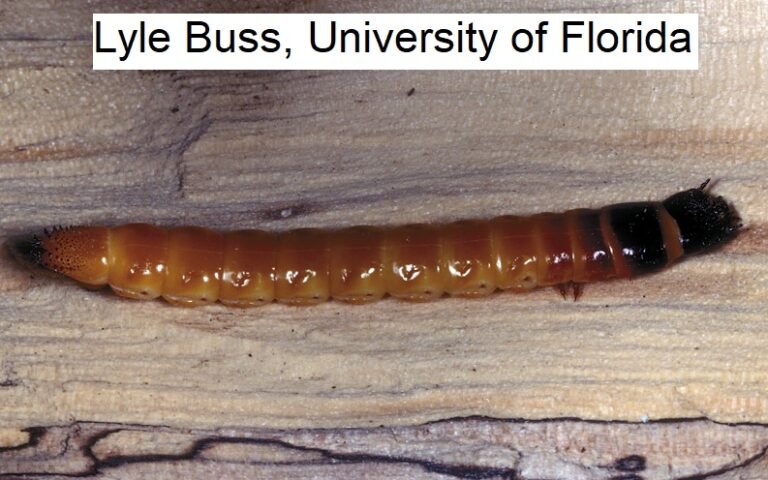
Food: not a lot is known about their habits, but it seems the adults may feed on the nectar and pollen of flowers, and the larvae of click beetles, called wireworms, live in the soft wood underneath the bark of dead trees searching for smaller insects to eat. They look similar to the mealworms sold in pet stores.
Season Most Active: in Florida they are most active in mid to late summer and can be found around porch lights in the evenings.
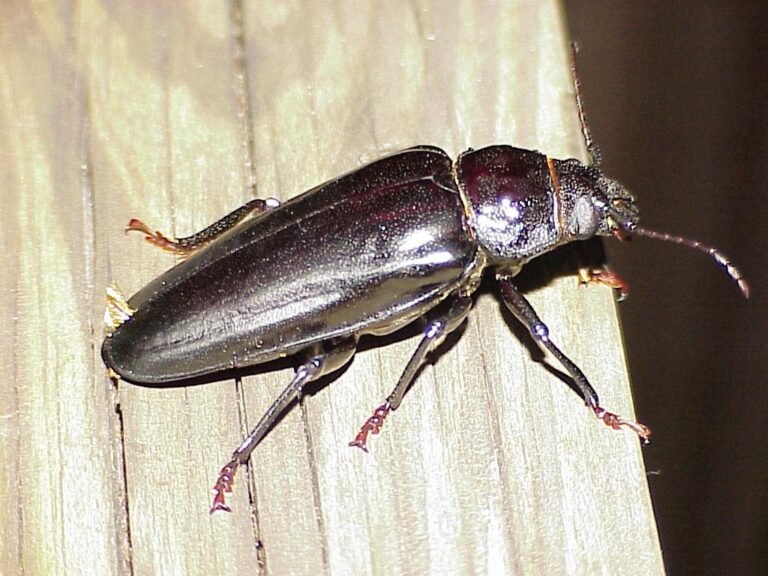
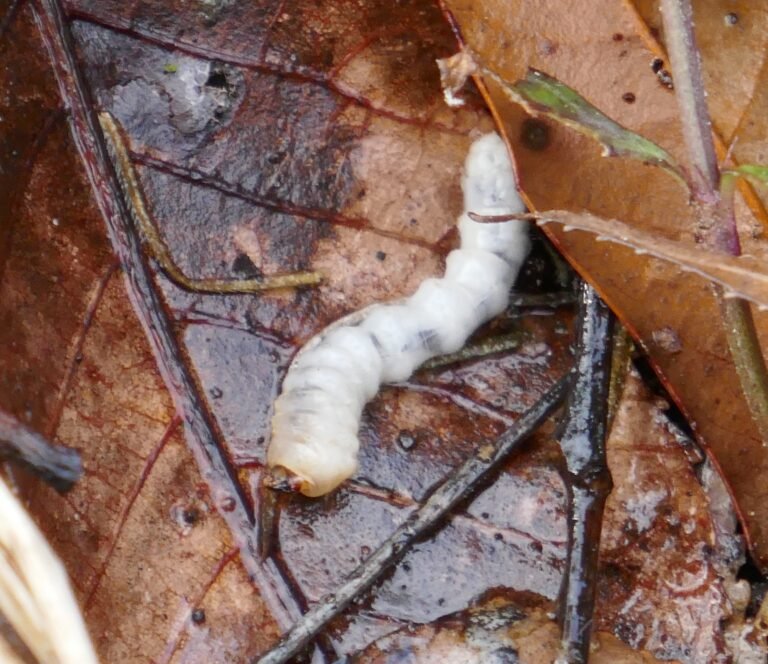
Archodontes melanopus
(live-oak stump borer beetle)
Description: the live-oak borer is a very large brown beetle that grows from 2 to 4 inches in length with very large mandibles that can give quite a painful bite. They are in the longhorn beetle family but have relatively short antennae compared to others in that family.
Common Names: live-oak borer, live-oak stump borer, and hardwood stump borer.
Latin Name: Archodontes melanopus.
Family: it is found in the Cerambycidae, or long horn beetle, family.
Behavior: the live-oak stump borer is most active at night and is usually seen flying into porch lights. It is quite intimidating and can give a painful bite if they feel threatened. Most of their activity occurs at night. It searches for a mate and lays eggs on live oaks with the larva boring into the wood creating tunnels. Too many of these on a live tree can certainly cause damage to its ability to cycle nutrients as the beetles create channels that obstruct the flow of nutrients to the tree. They are an important component of a forest because they recycle a large amount of wood throughout their life cycles as adults and larva.
Habitat: the live-oak borer is found in forests, coastal areas, and savannahs that include live oak trees.
Range: native to most of Florida and the southeastern United States.
Food: live-oak stump borers feed feed on the wood, roots, stems, and stumps of live oaks and other hardwoods. Both adult and larva have the same diet although some literature states that the adults do not eat.
Season Most Active: late spring, summer and early fall.
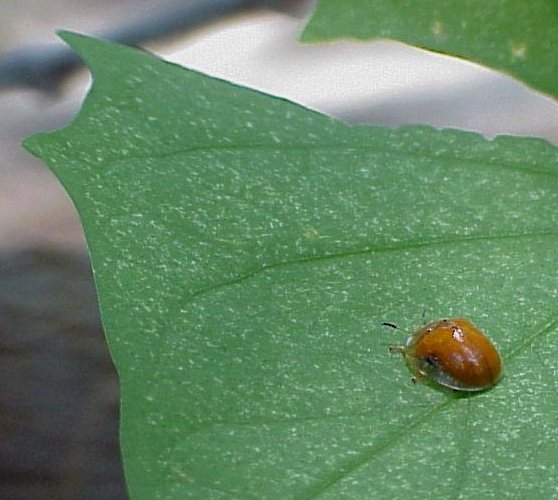
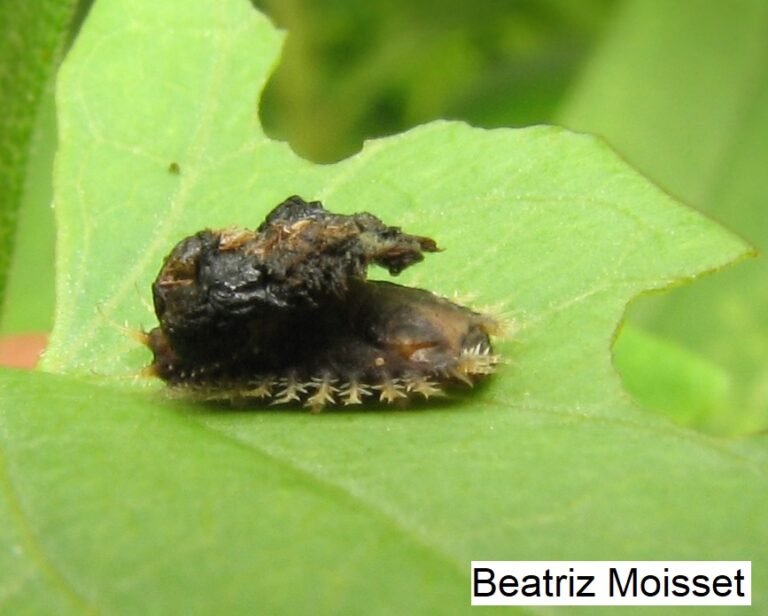
Charidotella bicolor
(golden tortoise beetle)
Description: the golden tortoise beetle is orange to metallic gold in color with a clear outer shield covering their prothorax and elytra. They are about 1/4 of an inch in size.
Common Names: golden tortoise beetle, gold bug, and sweet potato beetle.
Latin Name: Charidotella bicolor.
Family: the golden tortoise beetle is found in the Chrysomelidae, leaf beetle, family.
Behavior: the adults hide under morning glory leaves and lay their eggs much like ladybug beetles do on the new growth of the vines. The larva are brown and covered in debris so can be hard to find unless you are looking for them.
Habitat: they are found in gardens, roadsides, and meadows, and just about anywhere morning glory vines grow.
Range: they are found throughout Florida, and along the eastern United States.
Food: both the adult and the larva feed on plants in the Convolvulaceae, or morning glory, family of plants. So if you grow morning glories you are likely to see these little beetles in your backyard. They are flat and attach their fecal matter, and other debris, on their backs to avoid predation and look like a tiny moving pile of debris. The pile of debris on their backs is called a fecal shield.
Season Most Active: they are most active in spring, summer and fall.
Chauliognathus marginatus
(margined leatherwing beetle)
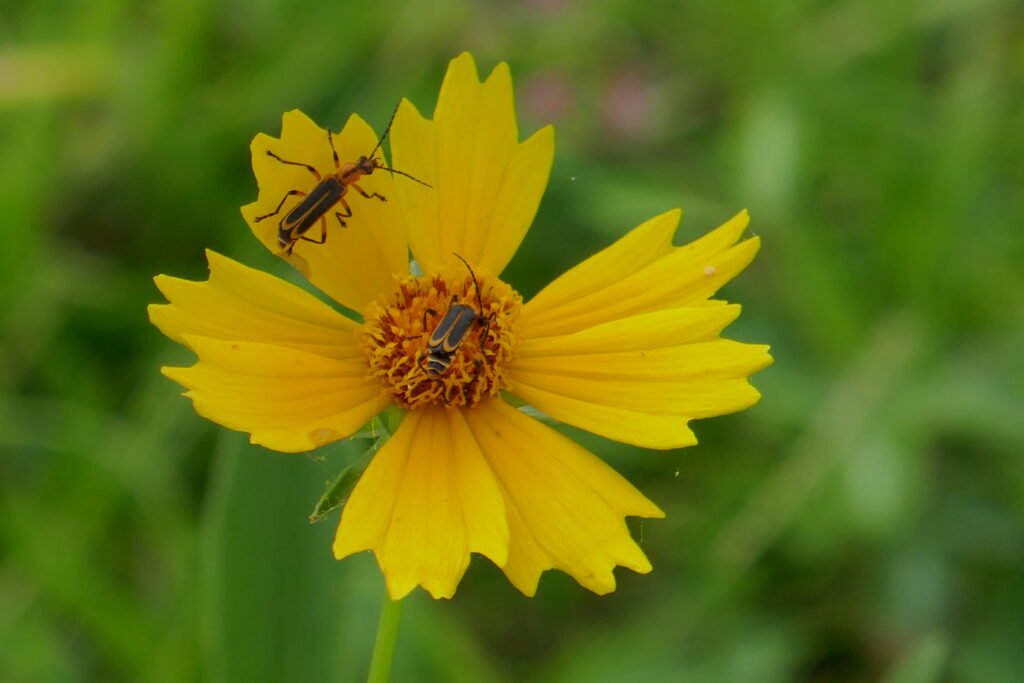
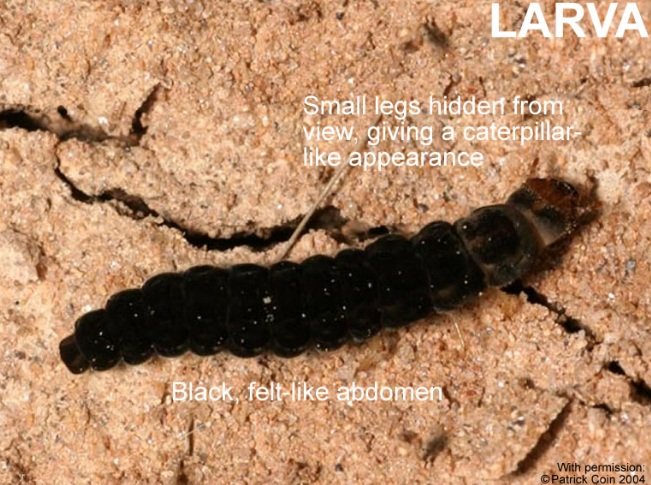
Description: margined leatherwing beetles have long slender bodies with orange bodies and black and orange wings. They grow to about 1/2 to 5/8 inch in length. They are sometimes mistaken for fireflies. The larva look similar to wire worms but with softer bodies.
Common Names: margined leatherwing beetles, soldier beetles and leatherwings.
Latin Name: Chauliognathus marginatus.
Family: the margined leatherwing beetle is found in the Cantharidae, or soldier beetle, family.
Behavior: margined leatherwing beetles are constantly visiting wildflowers to eat the nectar and pollen. They also eat small insects and their eggs so are considered great pollinators and natural pest management.
Habitat: they can be found in gardens, meadows, roadsides, and forests with blooming plants.
Range: the margined leatherwing beetle is found throughout Florida and the eastern United States.
Food: the adults feed on flower nectar and pollen and eat small insects and insect eggs while foraging. The larva feed on other insects and are known to attack corn earworm. So not only are the adults great pollinators the larva feed on potentially damaging insects.
Season Most Active: margined leatherwing beetles are most active in the spring and summer.
Cotinis nitida
(green June beetle)
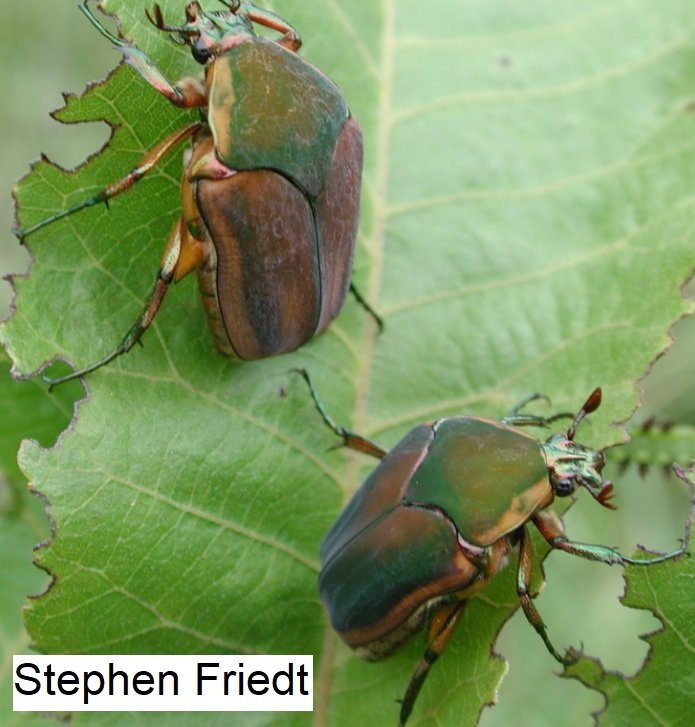
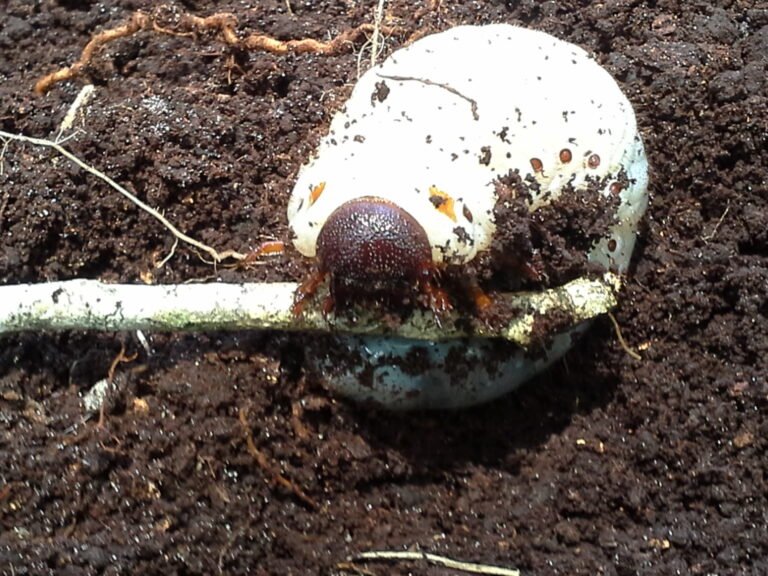
Description: green June beetles are usually a brilliant green color and grow to 1/2 to 1 inch in length. They fly low to the ground, and during the spring and summer they may collide with humans if you are in their pathway. They are not the most agile fliers and seem to bump into and bounce off things in their habitat. The larva, or grubs, have soft white bodies and a brown head. Sandhill cranes are known to spend hours spearing them in over manicured lawns.
Common Names: green June beetle, and June bug.
Latin Name: Cotinis nitida.
Family: they are found in the Scarabaeidae, or scarab beetle, family.
Behavior: the adults visit flowers, fruit trees, and tree sap. They are usually found looking for a nice lawn to lay their eggs in. At night they can be found flying around porch lights. The larva live in the soil and are rarely seen unless you dig one up.
Habitat: June beetles are found in lawns, agricultural fields, orchards, and forests. They love overwatered lawns because their larva/grubs eat the grass roots that the lush lawns provide.
Range: they are found throughout the eastern United States from New York south to Florida.
Food: the adults eat flower nectar, tree sap, ripe fruits, and anything sweet. The larva feed on organic matter and plant roots.
Season Most Active: they are most active in late spring through summer and can be seen flying into porch lights at night.
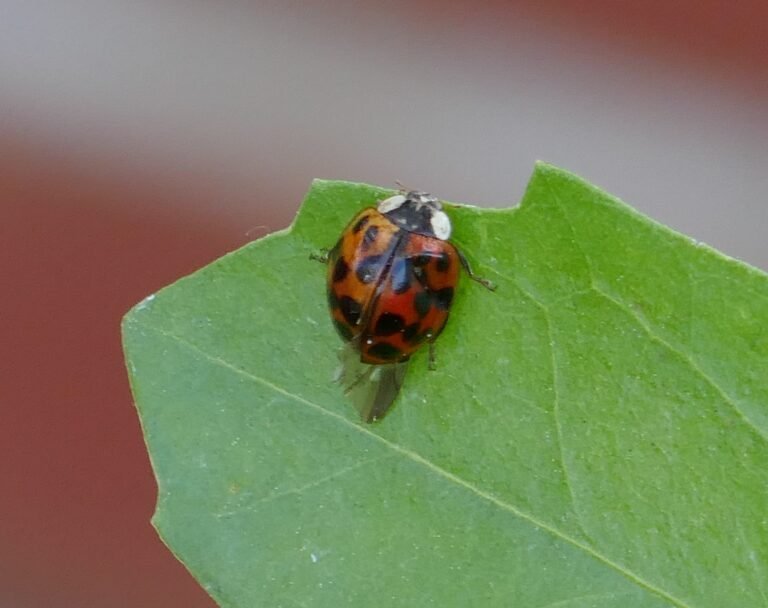
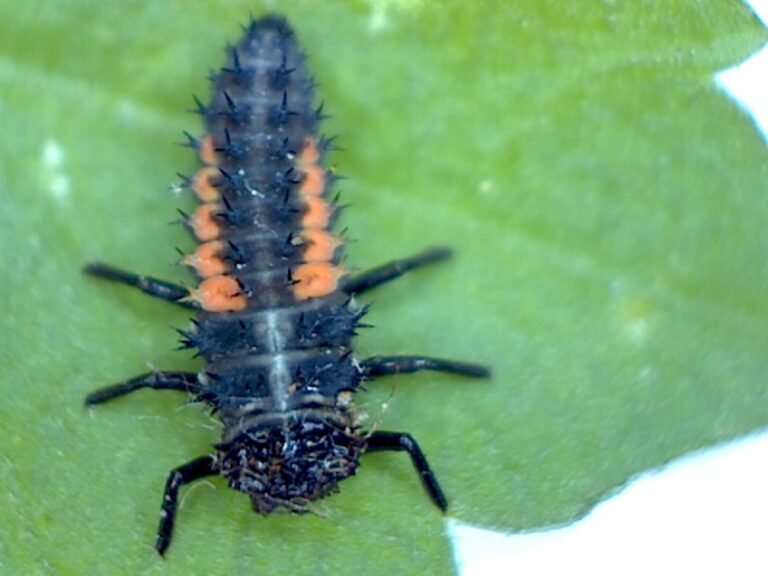
Harmonia axyridis
(Asian lady beetle)
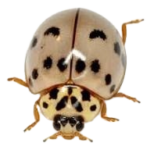
Description: Asian lady beetles are red and black with some having many black spots and others only a few.
Common Names: Asian lady beetle and Asian ladybug.
Latin Name: Harmonia axyridis
Family: they are found in the Coccinellidae, or lady beetle, family.
Behavior: as with most lady beetles the adults and larvae peruse plants that have aphids on them searching for aphids to eat and laying eggs underneath the leaves near where aphids are most abundant.
Habitat: they are found in most gardens, roadsides, meadows and forests.
Range: these non-native beetles originate from China, Japan, Korea, Mongolia, Russia and Siberia and are found throughout the USA and Florida. They are displacing our native lady beetles by out consuming food sources and out producing young.
Food: both adult and larva feed on aphids.
Season Most Active: they are most active in the spring and summer. During the winter they can be found hiding from the cold weather in homes, outbuilding, and any manner of human habitations.
Lady Beetles Native to Florida
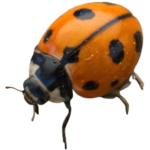
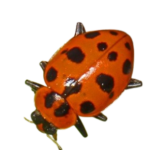
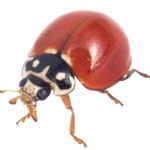
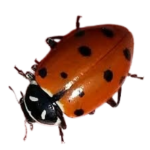
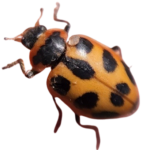
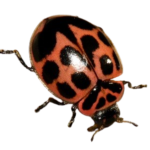
Coccinella novemnotata (nine spotted lady beetle) is native to the USA and New York’s state insect.
“Up until the mid-1980’s, New York’s state insect, the native ladybird beetle, Coccinella novemnotata (C-9) was the most common lady beetle (coccinellid) in the northeastern U.S. This relatively large (5-7 mm) species ranged across the U.S. and through Southern Canada and was an important biological control agent in gardens and crops in the northeast. Collections of C-9 declined through the mid to late 1980’s. The latest reported collection in the northeastern U.S. was 1992 …”
“Fortunately, although C-9 has declined precipitously some recent discoveries indicate that it continues to persist. Jilene (age 11) and Jonathan (age 10) Penhale found a nine spotted ladybug near their home in Virginia in October 2006 (read more about this discovery). This is the first C-9 seen in the eastern U.S. in 14 years. Their finding confirmed that the species is not extinct and gave specialists a place to start some intensive hunting. Recent sitings were also recorded from Alberta, Canada (Ladybugs of Alberta, John Acorn, 2006) and Nebraska in 2007 (Scott Black, Xerces Society, 2007). A new citizen science project has been launched at Cornell (the Lost Ladybug Project) to educate the public on the importance of biodiversity and conservation and to recruit them to join in the effort to document the current status of C-9 and other rare ladybug species.” [3]
Below are photos of our native lady beetles.
Hylotrupes bajulus
(old house borer beetle)
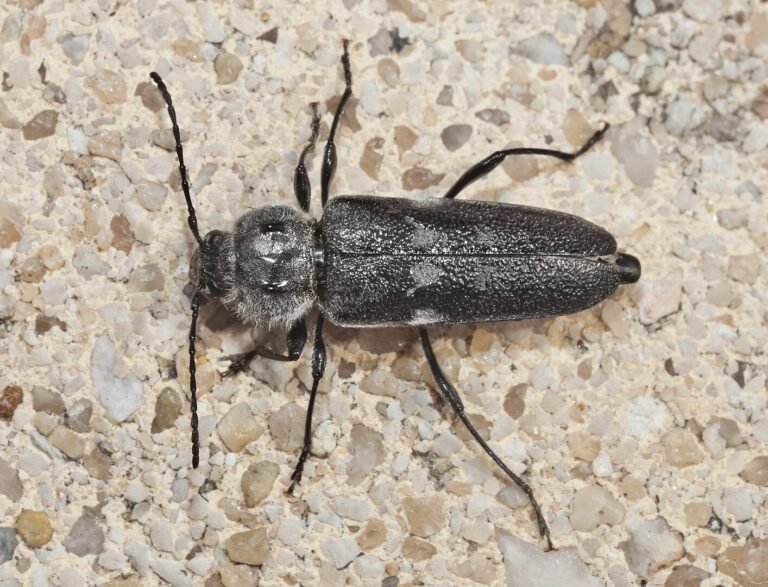
Description: the old house borer beetles are black to brownish beetles with long antennae that grow from 1/3 of an inch to 1 inch in length. They have two grayish spots on their elytra (wing coverings) and two shiny knobs on their thorax behind their heads.
Common Names: old house borer beetle, house longhorn beetle, old house borer, and European house borer.
Latin Name: Hylotrupes bajulus
Family: the old house borer beetle is found in the Cerambycidae, or long horn beetle, family.
Behavior: they are most active in summer months with the males actively searching for females. Once the females become fertile they search for spots to lay their eggs in cracks and crevices of softwood timber like pine, spruce and fir. Just because you may find one of these in your green space does not necessarily mean it it chewing on the wood in your home so don’t panic. Only panic if you see lots of them in any given area of your home.
Habitat: they are found in dead coniferous forest with pine, in homes (roof trusses, beams, flooring) and stored timber. It thrives in warm, dry, conditions and is often found in poorly ventilated areas. It is native to Eurasian but has a global distribution. Its presence is almost always linked to human structures, especially newer constructions with softwood timber.
Range: they are native to Eurasia but are found throughout the Unites States.
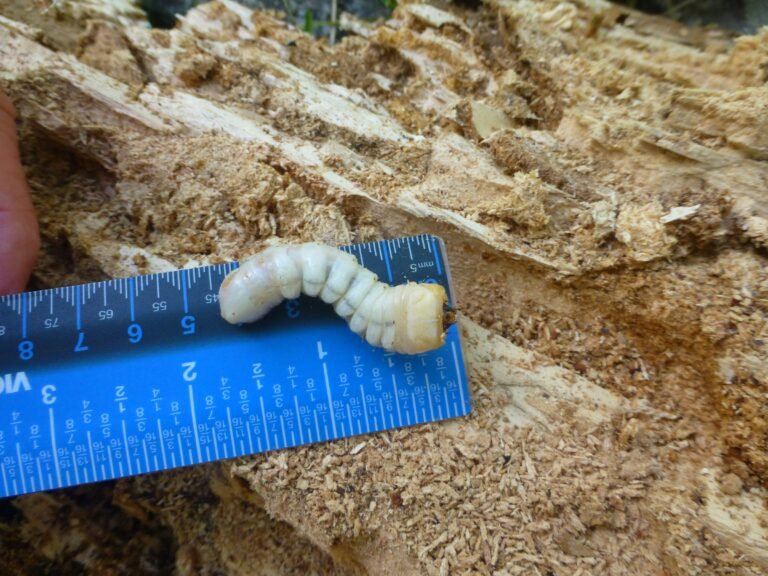
Food: the larval stage is quite prolonged and can last from two to 15 years. They eat and create tunnels in the wood sometimes they can be heard chewing with a raspy or clicking sound. The larva eventually pupate and when the adult emerges it chews its way out of the wood leaving frass (sawdust and poo) and a 1/4 to 3/4 inch exit hole in the wood. Most literature states that the adults do not feed. They use a lot of dead wood in forests for their egg laying and don’t specifically target just homes.
Season Most Active: the old house borer beetle is most active in summer months with the males actively searching for females and once the females are fertile they search for wood to lay their eggs in.
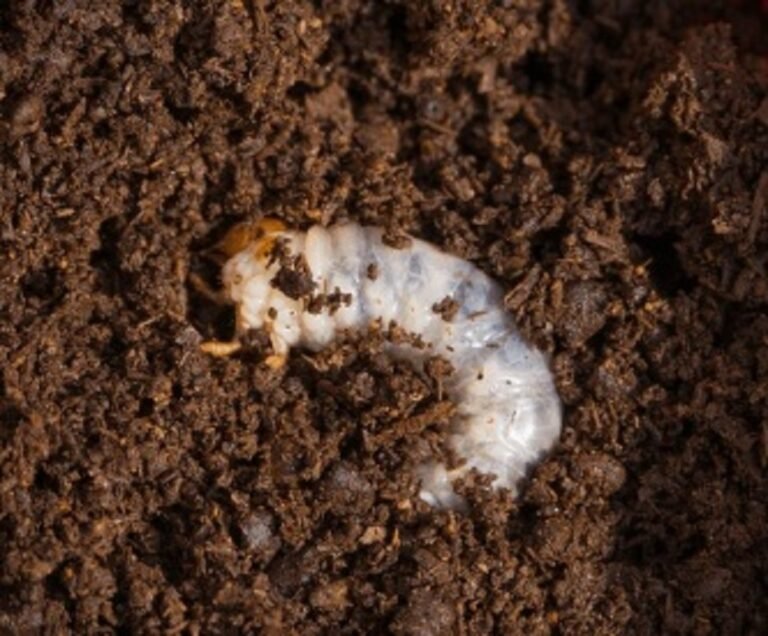
Phanaeus vindex
(rainbow dung beetle)
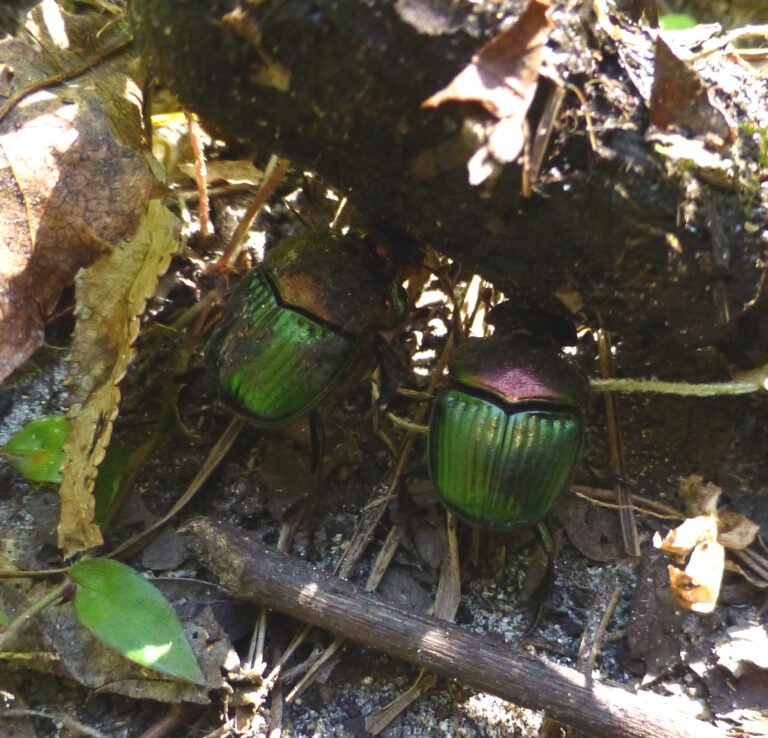
Description: the rainbow dung beetle has iridescent metallic green/blue elytra (wing coverings) that grow from 1/2 to almost 1 inch in length. The males have a long horn that curves over their back and are extremely colorful. The females are just about as colorful but lack the horn.
Common Names: rainbow dung beetle and rainbow scarab beetle.
Latin Name: Phanaeus vindex
Family: they are found in the Scarabaeidae, or scarab beetle, family.
Behavior: the rainbow dung beetle digs chambers in which to store dung and lay their eggs. They lay their eggs on dung pats they create and the larva hatch and feed off of it until they pupate and then emerge as adults. They are not very good flyers and bump into things and people. They are most active in the afternoon sunshine and spend winters underground.
This species is not the one that rolls the balls of poo although these do move it closer to their preferred soil. These spend most of their time burrowing and placing poo in their burrows to lay eggs on.
Habitat: rainbow dung beetles prefer clay soils where animal dung is available so they are found in pastures, forest edges, gardens, and roadsides. Clay soil is easier for them to burrow into so they are not found in sandy areas like coastal dunes or the keys. I have always seen them in my yard moving dog poo.
Range: rainbow dung beetles are found in the eastern and central Unites States. They are found throughout Florida with the exception of the Keys and Everglades.
Food: both adults and larva feed on animal dung. They prefer cow, pig and opossum. They do not like carnivore dung. These little beetles are great at adding organic matter to the soil throughout their daily activities.
Season Most Active: warm months from late spring to late summer.
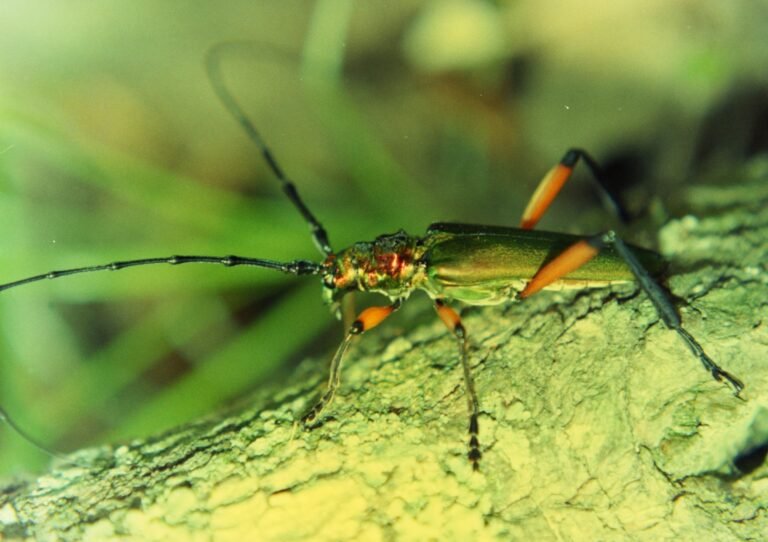
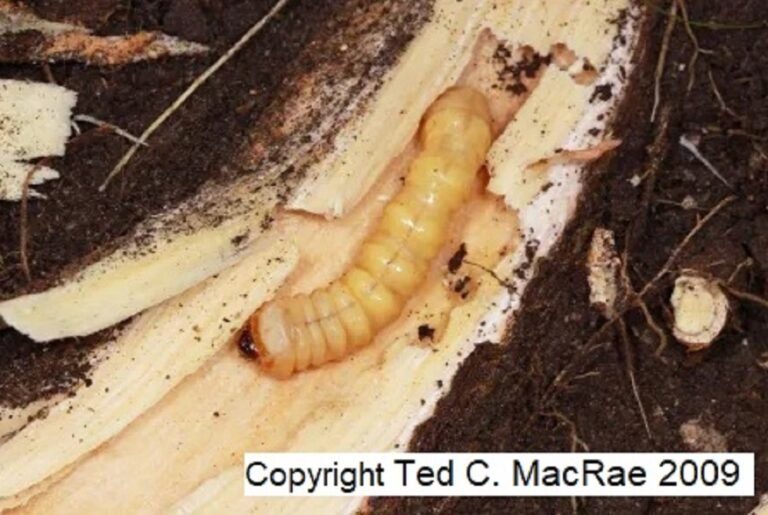
Plinthocoelium suaveolens
(eastern bumelia borer)
Description: the eastern bumelia borer is a large metallic green beetle with long antennae and orange legs. They are typically 1 to 1 1/2 inches in length.
Common Names: eastern bumelia borer, long-horn beetle, bumelia borer, and ponderous borer.
Latin Name: Plinthocoelium suaveolens
Family: the eastern bumlia borer beetle is found in the Cerambycidae, or long horn beetle, family.
Behavior: they roam around native forests in search of Bumelias, mulberries, and tupelo trees on which to lay their eggs. While doing so search for nectar and over ripe fruit to consume as they go about mating and laying eggs.
Habitat: this beetle prefers dry sites such as dry oak forests, pinelands, and other places where its main larval food source is available.
Range: the eastern bumelia borer is native to the United States from Florida to Arizona and north to Missouri. It is primarily found in Texas, Florida, and the southeast.
Food: the adult eastern bumelia borer eats nectar and over ripe fruit while the larva feed on Bumelia tree roots. They prefer Bumelia but will also use tupelo, mulberry, and other native tree roots on which to lay their eggs.
Season Most Active: the eastern bumelia borer beetle is most active in late spring to fall. They are nocturnal so are usually seen around porch lights on warm nights.
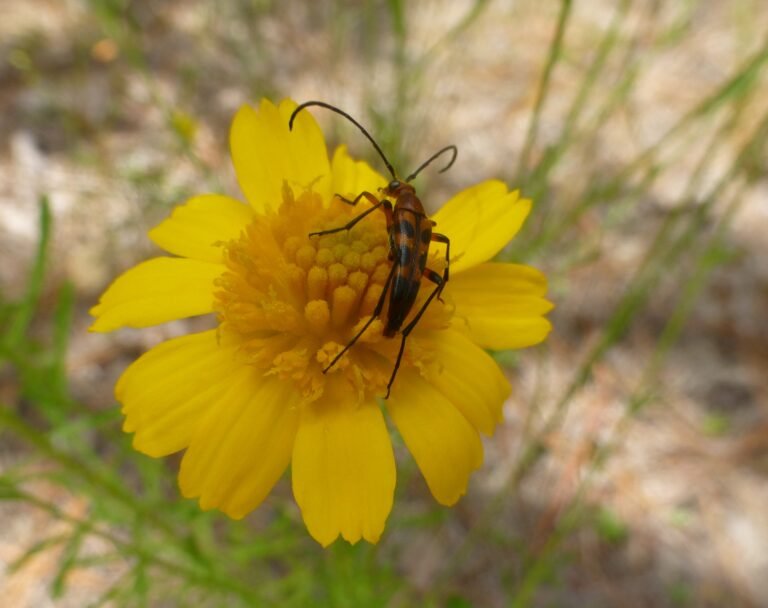
Strangalia famelica
(slender flower longhorn beetle )
Description: the slender flower longhorn beetle is slim black and orange beetle with long antennae. They are about 3/8 to 5/8 inches in length. Their elytra often have black bands or spots on them.
Common Names: slender flower longhorn beetle, flower longhorn beetle, and hungry strangalia.
Latin Name: Strangalia famelica
Family: it is found in the Cerambycidae, or longhorn beetle, family.
Behavior: they are active during the day so can be found among blooming flowers consuming nectar and pollen. Mating pairs can be seen on flowers. Once the female is fertile she searches for decaying wood to lay her eggs on.
Habitat: slender flower longhorn beetles can be found in forest edges, gardens, meadows, roadsides with blooming flowers.
Range: they are native to the southeastern United States and can be found from Massachusetts south to Florida and west to Oklahoma.
Food: the slender flower longhorn beetle adults feed on flower nectar and pollen, and the larvae bore into dead wood.
Season Most Active: they are most active in late spring, summer, and fall when flowers are blooming.
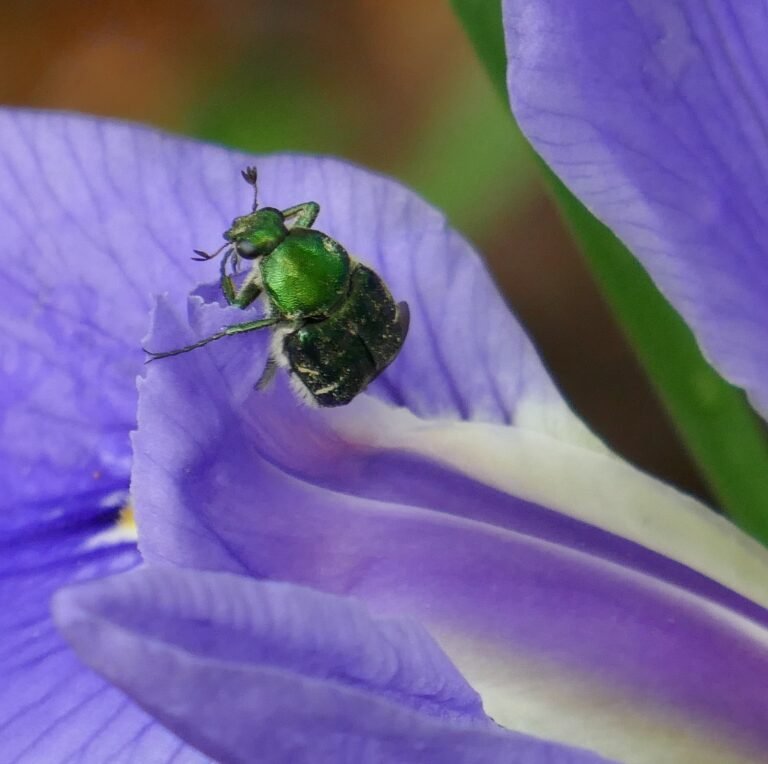
Trichiotinus lunulatus
(emerald flower scarab beetle)
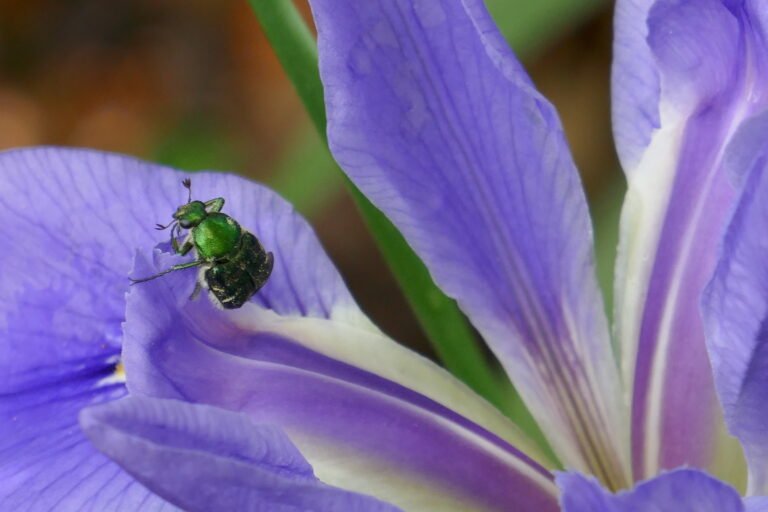
Description: the emerald flower scarab beetle is a small metallic green/blue beetle with a shimmering sheen. It only gets to about 1/2 an inch in length.
Common Names: emerald green scarab beetle, metallic green flower beetle, and flower scarab.
Latin Name: Trichiotinus lunulatus
Family: they are found in the Scarabaeidae, or scarab beetle, family.
Behavior: between their clumsy flying and buzzing sound they draw attention to themselves as they visit garden flowers. The buzzing sound is similar to a bee and is said to be a form of communication.
Habitat: forest edges, meadows, parks, and just about any sunny spot with flowers growing and nearby woods with rotting hardwood.
Range: the emerald flower scarab beetle is native to the southeastern United States and is found from Maryland south to Florida and west to Texas.
Food: the adults feed on flower nectar and the larvae feed on rotting wood.
Season Most Active: the emerald flower scarab beetle is most active in the spring and summer.
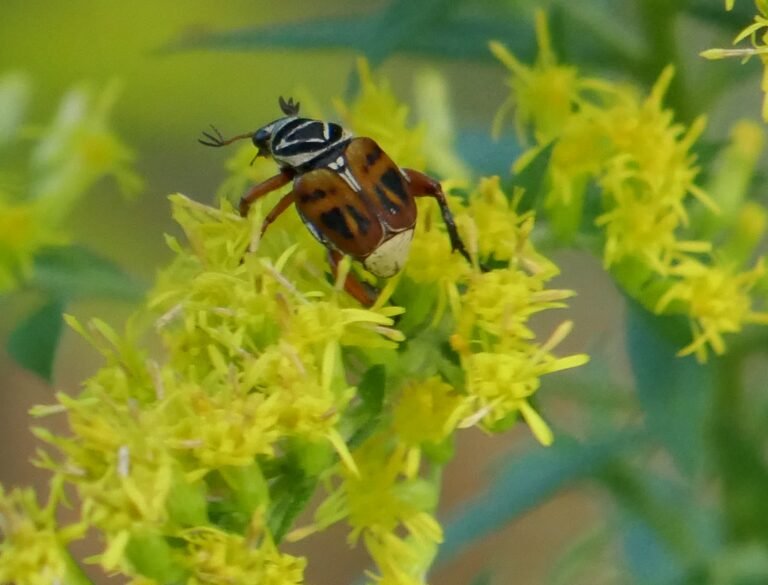
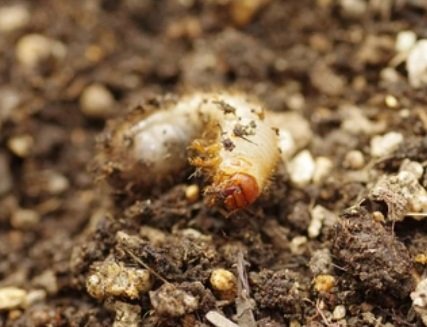
Trigonepeltastes delta
(delta flower scarab beetle)
Description: delta flower scarab beetles are a little less than half an inch in length. They are rust colored with a distinctive black head, thorax and body. The pronatum (area just behind the head) has a yellow triangle on it hence the “delta” name.
Common Names: delta flower scarab beetle, delta flower beetle, and flower chafers.
Latin Name: Trigonepeltastes delta
Family: they are found in the Scarabaeidae, or scarab beetle, family.
Behavior: the adults feed on flower nectar so this beetle can be seen flying around during the day from flower to flower. It has an odd behavior of lifting its rear legs up as it feeds.
Food: The larva feed on decaying wood so are not often seen unless the wood breaks open to expose them. They have also been found feeding on the decaying vegetation of our native bromeliads.
Habitat: the delta flower scarab beetle may be found in any environment with trees and flowers from mesic to xeric. The adults are constantly on the move during the day in search of nectar. They love cabbage palm nectar and when the trees are on bloom hundreds can be found on just one tree.
Range: they are native to the southeastern United States and found throughout the state of Florida.
Food: the adults consume flower nectar and the larvae eat decaying wood.
Season Most Active: delta flower scarab beetles are most active during late spring and early fall with the adults searching for food, mating, and laying eggs in soft wood.
Footnotes
[1] Milne and Milne. The Audubon Society Field Guide to North American Insects and Spiders. Knopf, N.Y. New York. 1992.
[2] Deyrup and Kenney. Florida’s Fabulous Insects. World Publications. 2000.